Best selling wood projects
There has been much discussion about the pros and cons of various ukulele makes - from a wide range of different manufacturers. Any Ukulele Forum will have a place for this kind of discussion. I would like to comment upon some ukuleles made in Saigon, and marketed under the Bruce Wei label.
These are sold via his ebay store under
bruceweiart and
bruceweiguitars pseudonyms.
The first thing to realise is that there are so many different types and styles of ukulele, produced as Bruce Wei. Apart from the traditional Soprano, Concert, Tenor and Baritone ukes, there are a multitude of different styles within these four sizes.
In Soprano, one can choose from hourglass or cutaway, in standard or long necked versions. The long necked have a concert sized neck on a soprano body.
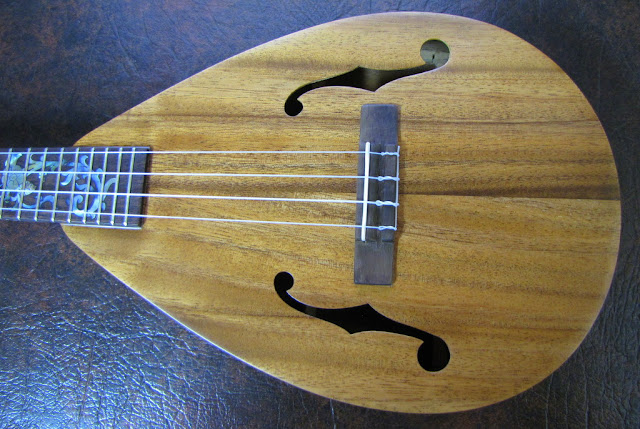
Concerts come in a slightly bigger range of body shapes - including the two above, as well as teardrop. There is no production long-necked concert ukulele from Bruce Wei at the moment - perhaps in future. He will, however, custom make one if so desired. Sound hole placement on the concerts can include the f-holes variation adjacent the bridge, as well as the standard round three-quarter hole on the soundboard.
Tenor ukuleles show the most variety. As well as the three styles mentioned for the others, there are: boat paddle, balalaika-style flat ended, pear shaped cutaways, tear drop cutaways that resemble a leaf - and all come with or without bindings.
Baritone ukuleles come in one shape - standard hourglass, with standard and f sound holes. There is an archtop variation, but this looks tricky to play.
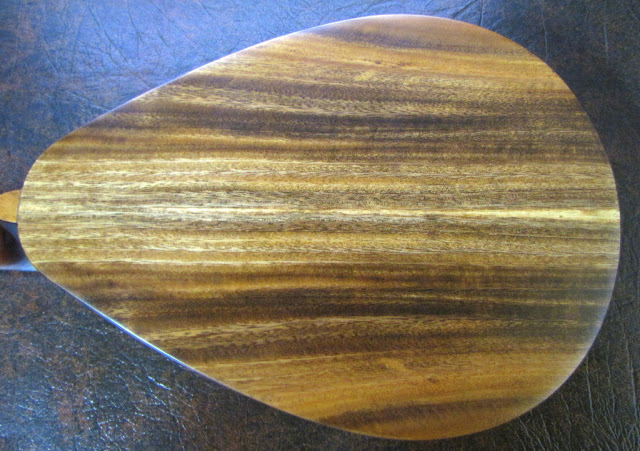
Sound hole placement on the tenors can vary enormously - from standard three quarter rounds to side fs, upper bout paired scrollwork, birds, turtles etc etc. Sometimes the upper bout soundholes are accompanied by one in the side of the body - either high or low. The pear shaped cutaways can have an extra sound hole in the back that is fitted with scrollwork.
There are four, six and eight string tenor ukes - the latter two being standard hourglass shapes.
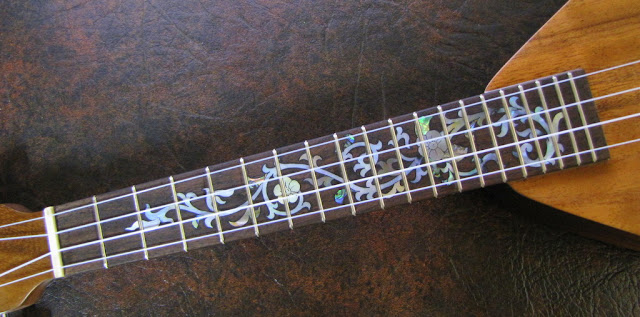
And just to add two more variables to all Bruce Wei ukulele sizes - the body and/or the neck can include timber or mother of pearl or abalone inlay.
It would take an age to review all of the permutations and combinations of Bruce Wei ukuleles. Here I am going to limit myself to just a few.
I am going to make an assumption based upon my direct observations of work practice in Saigon, as well as the sheer diversity that exists within even the one style of instrument marketed under the Bruce Wei brand. It is common for western production methods to centralise manufacture within a single building or factory, and to complete most, if not all the stages of the manufacturing process under the one roof. This can be efficient and cost effective.
Vietnamese manufacturing may head in this direction, but it is more common to see small operators, in family-run businesses, sub-contracting to a centralised marketing hub, I believe that this is the model being utilised for the manufacture of these instruments. It explains why there are so many variations within even the one style of ukulele.
For example, concert body shapes of the hourglass design are not consistently the same profile. The waists vary - depending on where they were sourced. This is not a bad thing, but it does make quality control more difficult.
One thing that all Bruce Wei ukuleles seem to have in common, is that they are all hand built. Made of solid woods, there are no laminated ukuleles from this manufacturer. In a sense, they are all custom made instruments - no robots, no assembly line - no two ever the same.
Timber selection in the Bruce Wei range is based around proven tonewood performers - acacia koa, mahogany, maple and spruce (and occasionally rosewood) for the bodies, mahogany for the necks and Indian rosewood for the fretboards and bridges. Headstocks vary, but are usually acacia koa or Indian rosewood. There are always MOP or abalone fret markers (except in the case of fretboard inlay), and it is most uncommon for the fretboard to not have side markers as well.
Strings are nearly always Italian Aquilas.
Quality shown on all the ukuleles is truly excellent. The satin finish is impeccable, and all glued joints are tight, with barely noticeable seams. Bruce admits that years ago, when he first started, quality control was his strongest challenge, but these challenges have been successfully met - and currently quality control is a strong point in his line-up.
The backs are radiused in most cases, but the soundboards are flat. In the larger ukulele bodies, this may lead to distortion around the bridge as the instruments age, but there is little sign of that at the present. The one improvement that the larger ukuleles could use, is a gently radiused soundboard. Not only would it add strength, it looks more attractive in my view. The generally accepted soundboard radius is 22 feet if I recall correctly.
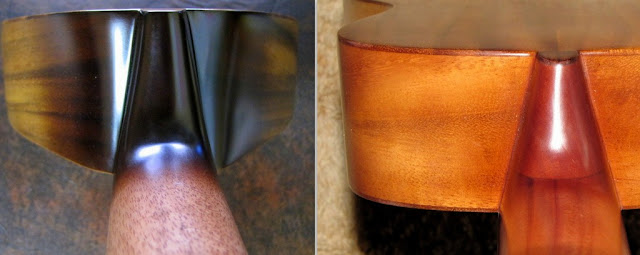
The fit of the necks to the bodies is particularly impressive, as is the neck shaping and sizing.
In combination with the fretboard, the mahogany necks are a work of art and exceptionally comfortable to play.
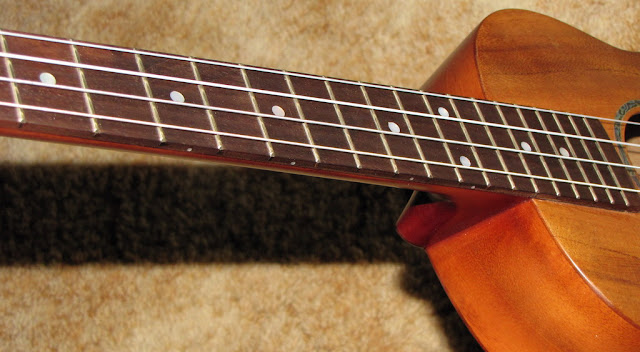
The fretboards are Indian rosewood - hard and durable - and the scale on each is exact. They are as straight as a die and the frets themselves have been nicely bevelled along both edges. Inlaid fretboards eschew the surface dot markers, but plain rosewood fretboards have MOP or abalone. Usually these are the standard dots, but sometimes they are dressed up as birds, dolphins and other exotic shapes. All fretboards have inlaid MOP side markers at the 5th 7th, 10th and 12th frets and many have one at the 3rd.
The action on all the ukes is well set - not too high and with no buzzing. Nuts and saddles are of quality buffalo bone - no plastic here.
Tuners are low geared requiring quite a lot of initial winding to bring the strings up to pitch, and require a lot of fiddling during the first week or so as the strings stretch. Once the strings settle down, the low gearing is an advantage, and gives a precise adjusting mechanism in finding the correct tuning for each string.
All of them play and resonate well, with good sustain and clean and clear intonation. There are differences in volume which I put down to the different body designs.
There are also differences in tone which reflect the chosen wood used in construction - particularly the body, and most especially the soundboard. Mahogany sounds brighter and louder than does the acacia koa - which, to my ear, sounds more mellow.
There are hundreds of different brands and types of ukuleles on the market, endeavouring to meet a burgeoning demand for an instrument whose popularity has risen dramatically over the last few years. There may have been a time in the past when musical instruments from Asia were looked upon as toys - particularly in the case of ukuleles. Not any more.
These are serious instruments - made to a performance standard - that anyone would be pleased to own and play. Apart from their beauty, their other attraction is their unparallelled value for money, and the fact that at this time - postage or freight costs are included in the price.
I am delighted with mine and am pleased to recommend them
As Teddy Roosevelt says ............
...... Speak softly ... and carry a ukulele ............May your problems be small ones and your joys many .................
Post Script September 2014:
It is around two years since I first wrote this review.
I have written a Follow Up Review on my blog here:
PART TWO - What a difference time makes. Best selling wood projects