Pages

Tampilkan postingan dengan label ukuleles. Tampilkan semua postingan

Selasa, 22 Maret 2016

Best selling wood projects - Making A Boat Paddle Tenor Ukulele Part 13 Nearly There

Best selling wood projects

Best selling wood projects


Fretboard

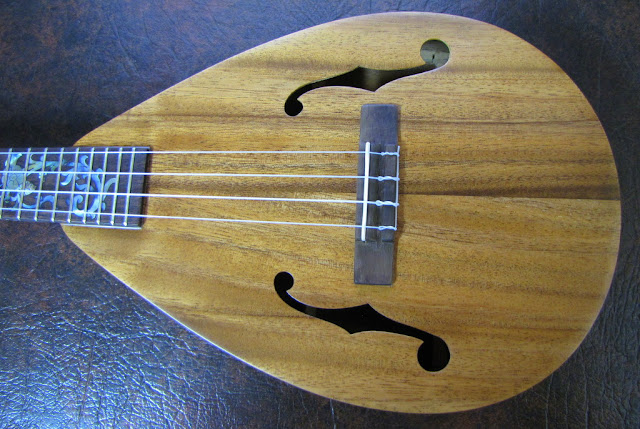
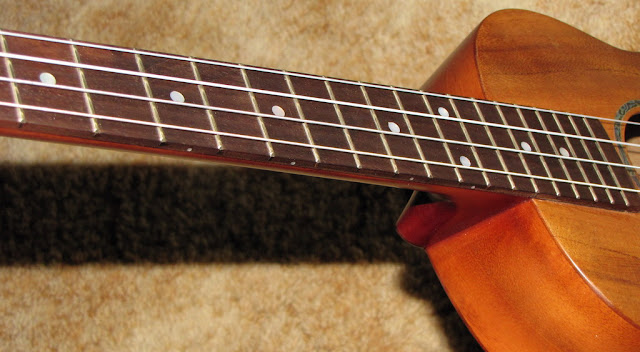
I decided that the inlaid fretboard would be too busy aesthetically on this mango timber, and have opted instead for a straight plain-jane variety, with simple fret-marker inlays of mother of pearl (MOP)
Marking out the fretboard is very easy once the length of scale is known.
This wonderful online calculator is invaluable:
http://www.stewmac.com/FretCalculator


I mark mine with a scribing knife before cutting them with a narrow-kerf tenon saw.
While the piece of African blackwood is still square,  I mark the positions for the MOP markers - frets 3, 5, 7, 10 and 12 in this case.
These are glued in place and left to dry before cutting the tapers on the fretboard sides to match the existing neck.


Fret-wire is simply hammered into position in the grooves cut by the tenon saw, and snipped to size with a pair of side-cutters.


This little wooden mallet works very well.


A square file is used to trim the overhanging fret-wire from the edges.


When flush, the top edges are filed at 45 degrees to create a chamfer on the corners of the frets themselves.


I find it easiest to do this on a sanding mat that holds the fretboard in place while I file.
There isnt a lot of room for big fingers, so any assistance is welcome.
Once this is complete, I will seat all of the fret-wires with a straight board and an iron hammer to ensure that they are all straight and parallel to each other.


Here is a trial fit with the bone nut in place to see how well everything is coming together.  I dont glue the bone nut in at this stage, as it may need adjusting in height after the bridge is added - to obtain the correct playing action for the strings.


I have selected a piece of Indian rosewood for the headstock, and this has been glued over the laminated head to add a little beauty - and to hide the strip laminations.


I add tape alongside the end of the fretboard to cover the body from excess glue squeeze-out.  It is also a handy fitting guide when the fretboard is glued in place.


Here we are with the glued fret-board held in place by spring-clamps.  Notice that the bone nut is here to establish the fretboard position - it is removed once the clamps are all secure, as I dont want stray glue fixing it in position just yet.


Here we are then - all but finished.
I will next mark out and drill the holes for the headstock tuners.
Only the bridge to add, then follow that with final sanding and finishing.
Nearly there ................
Best selling wood projects
Read More..

Minggu, 13 Maret 2016

Best selling wood projects - Kids and Woodwork A Happy Combination

Best selling wood projects

Best selling wood projects


When do you first remember enjoying woodwork?


For some people it is later in life, when there is a stirring within the creative spirit - to embrace a hobby that has so many sensory rewards.  The smell of freshly cut camphor laurel, the heady touch of freshly worked huon pine, the sound of shavings coming off the plane.


Timber is so thoroughly organic, that in using it we allow our senses to reach out and experience a small part of what makes up the soul of a tree.

While few of us will ever be in the same league as George Nakashima, we do - like him - allow ourselves to attempt to bring out the innate beauty of that most wonderful of materials - timber.


I would venture to say of most woodworkers, that the woodworking seed was planted within our being when we were very young.


How many of us picked up a hammer because we saw our dad do it?


Did we see our grandpa drilling a hole and longed to try it ourselves?  Use a handsaw, and simply want to cut wood like he did?


That is certainly what happened to me.  Growing up as a baby-boomer in a suburb of housing commission homes, there was no shortage of role models who were daily working with wood.  Parents and grandparents were all part of the can-do generations that were spawned by the Great Depression.
We were always making something - cubby houses, bows and arrows, boxes, toys and what we would have called furniture.  Our families were gracious and understanding enough to even allow some of this furniture inside the house.


Now, it seems, it is my turn to be the mentor for a new generation of prospective woodworkers.  Whod have thought that Generation Z-ers who are the classically networked and i-lived generation, would have a yen for something so far out of left field (for them) as woodwork.


And yet there it is.  They have discovered the joys of using something substantial, that can be handled, rotated, shaped, assembled and presented as a finished product to be proud of - the work of their hands.

These are the same hands that daily explore virtual reality, where the only thing that is real is the screen in front of their eyes.  No wonder their spirit hungers for substance.

I think that George Nakashima would be delighted -

.......................... I know that I am!

Best selling wood projects
Read More..

Sabtu, 12 Maret 2016

Best selling wood projects - Bruce Wei Ukuleles A Follow Up Review

Best selling wood projects

Best selling wood projects


Bruce Wei Ukuleles - A Follow-Up Review

It is now around two years since I reviewed a range of ukuleles made in Vietnam under the Bruce Wei label.
The original review is to be found here:

Bruce Wei Ukuleles - A Small Review 

 Over the intervening period, my ukulele playing has felt most comfortable on tenor sized ukes so these are the ones that have had the most use.
I have onsold to other ukulele lovers all other sized - soprano and concert ukes - that I have owned and I am left with just two Bruce Wei tenors.


This is one tenor that has really grown on me.  It has an Indian rosewood body and a spruce soundboard together with a maple neck.


There were many online criticisms of Vietnamese and Taiwan-made instruments some years ago, based around some perceived lack of longevity in the construction.  Specifically some users claimed that the glue joints were prone to cracking or some such.


I have never seen any evidence of this and as can be seen from these images, the instrument is still superb in its appearance.  This uke has been played many times each week - at uke groups, workshops and concerts and it looks as good as it did when new.


Even the little details like the inlay, have not shown any signs of deterioration - something that happens on cheaper instruments over time.  
As it has aged, and with playing, it has really matured in sound producing a "rounder" and warmer tone with some growth in volume and sustain. 


My favourite instrument has grown to be the Bruce Wei 8 string tenor ukulele that I purchased around Xmas of 2012.
This one is made from solid mahogany - both body and soundboard - again with maple neck and a beautiful Indian Rosewood headstock.


Neither it nor the regular tenor came with bindings as part of the body, but I notice that some of the newer Bruce Wei instruments are now offering this feature.


The inlay details are as good as before and the finish superb.

Most importantly however, is the sound.  This instrument is such a joy to play.  No buzzing, perfect intonation and a wonderful depth of sound from those Aquila strings.


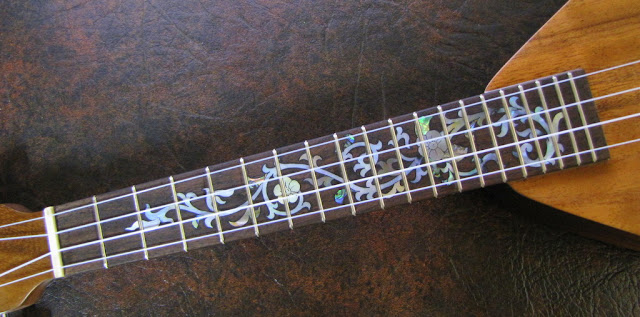
It came with a very busy fretboard inlay which at first I did not like for its complexity - I prefer simpler inlays - but now I dont notice it.  It does attract a lot of comment from other ukers and audience members of course.

I thought that after some years these comparatively cheap (to buy) instruments would start to show some limitations and failings.
I could not have been more wrong.
These are high quality ukuleles built to an excellent standard.
They are sounding truly wonderful, and as a value for money instrument cannot be surpassed in my humble opinion.


Best selling wood projects
Read More..

Senin, 15 Februari 2016

Best selling wood projects - Bruce Wei Ukuleles A Small Review

Best selling wood projects

Best selling wood projects


There has been much discussion about the pros and cons of various ukulele makes - from a wide range of different manufacturers.  Any Ukulele Forum will have a place for this kind of discussion.  I would like to comment upon some ukuleles made in Saigon, and marketed under the Bruce Wei label.
These are sold via his ebay store under bruceweiart and bruceweiguitars  pseudonyms.

The first thing to realise is that there are so many different types and styles of ukulele, produced as Bruce Wei.  Apart from the traditional Soprano, Concert, Tenor and Baritone ukes, there are a multitude of different styles within these four sizes.

In Soprano, one can choose from hourglass or cutaway,  in standard or long necked versions.  The long necked have a concert sized neck on a soprano body.


Concerts come in a slightly bigger range of body shapes - including the two above, as well as teardrop.  There is no production long-necked concert ukulele from Bruce Wei at the moment - perhaps in future.  He will, however, custom make one if so desired.  Sound hole placement on the concerts can include the f-holes variation adjacent the bridge, as well as the standard round three-quarter hole on the soundboard.

Tenor ukuleles show the most variety.  As well as the three styles mentioned for the others, there are: boat paddle, balalaika-style flat ended, pear shaped cutaways, tear drop cutaways that resemble a leaf - and all come with or without bindings.
Baritone ukuleles come in one shape - standard hourglass, with standard and f sound holes.  There is an archtop variation, but this looks tricky to play.
Sound hole placement on the tenors can vary enormously - from standard three quarter rounds to side fs, upper bout paired scrollwork, birds, turtles etc etc.  Sometimes the upper bout soundholes are accompanied by one in the side of the body - either high or low.  The pear shaped cutaways can have an extra sound hole in the back that is fitted with scrollwork.
There are four, six and eight string tenor ukes - the latter two being standard hourglass shapes.

And just to add two more variables to all Bruce Wei ukulele sizes - the body and/or the neck can include timber or mother of pearl or abalone inlay.


It would take an age to review all of the permutations and combinations of Bruce Wei ukuleles.  Here I am going to limit myself to just a few.

I am going to make an assumption based upon my direct observations of work practice in Saigon, as well as the sheer diversity that exists within even the one style of instrument marketed under the Bruce Wei brand.  It is common for western production methods to centralise manufacture within a single building or factory, and to complete most, if not all the stages of the manufacturing process under the one roof.  This can be efficient and cost effective.

Vietnamese  manufacturing may head in this direction, but it is more common to see small operators, in family-run businesses, sub-contracting to a centralised marketing hub,  I believe that this is the model being utilised for the manufacture of these instruments.  It explains why there are so many variations within even the one style of ukulele.

For example, concert body shapes of the hourglass design are not consistently the same profile.  The waists vary - depending on where they were sourced.  This is not a bad thing, but it does make quality control more difficult.


One thing that all Bruce Wei ukuleles seem to have in common, is that they are all hand built.  Made of solid woods, there are no laminated ukuleles from this manufacturer. In a sense, they are all custom made instruments - no robots, no assembly line - no two ever the same.

Timber selection in the Bruce Wei range is based around proven tonewood performers - acacia koa, mahogany, maple and spruce (and occasionally rosewood) for the bodies,  mahogany for the necks and Indian rosewood for the fretboards and bridges.  Headstocks vary, but are usually acacia koa or Indian rosewood.  There are always MOP or abalone fret markers (except in the case of fretboard inlay), and it is most uncommon for the fretboard to not have side markers as well. 
Strings are nearly always Italian Aquilas.


Quality shown on all the ukuleles is truly excellent.  The satin finish is impeccable, and all glued joints are tight, with barely noticeable seams.  Bruce admits that years ago, when he first started, quality control was his strongest challenge, but these challenges have been successfully met - and currently quality control is a strong point in his line-up.


The backs are radiused in most cases, but the soundboards are flat.  In the larger ukulele bodies, this may lead to distortion around the bridge as the instruments age, but there is little sign of that at the present.  The one improvement that the larger ukuleles could use, is a gently radiused soundboard.  Not only would it add strength, it looks more attractive in my view.  The generally accepted soundboard radius is 22 feet if I recall correctly.


The fit of the necks to the bodies is particularly impressive, as is the neck shaping and sizing.
In combination with the fretboard, the mahogany necks are a work of art and exceptionally comfortable to play.


The fretboards are Indian rosewood - hard and durable - and the scale on each is exact.  They are as straight as a die and the frets themselves have been nicely bevelled along both edges.  Inlaid fretboards eschew the surface dot markers, but plain rosewood fretboards have MOP or abalone.  Usually these are the standard dots, but sometimes they are dressed up as birds, dolphins and other exotic shapes. All fretboards have inlaid MOP side markers at the 5th 7th, 10th and 12th frets and many have one at the 3rd.


The action on all the ukes is well set - not too high and with no buzzing.  Nuts and saddles are of quality buffalo bone - no plastic here.


Tuners are low geared requiring quite a lot of initial winding to bring the strings up to pitch, and require a lot of fiddling during the first week or so as the strings stretch.  Once the strings settle down, the low gearing is an advantage, and gives a precise adjusting mechanism in finding the correct tuning for each string.


All of them play and resonate well, with good sustain and clean and clear intonation.  There are differences in volume which I put down to the different body designs.
There are also differences in tone which reflect the chosen wood used in construction - particularly the body, and most especially the soundboard.  Mahogany sounds brighter and louder than does the acacia koa - which, to my ear, sounds more mellow.

There are hundreds of different brands and types of ukuleles on the market, endeavouring to meet a burgeoning demand for an instrument whose popularity has risen dramatically over the last few years.  There may have been a time in the past when musical instruments from Asia were looked upon as toys - particularly in the case of ukuleles.  Not any more.
These are serious instruments - made to a performance standard - that anyone would be pleased to own and play.  Apart from their beauty, their other attraction is their unparallelled value for money, and the fact that at this time - postage or freight costs are included in the price.

I am delighted with mine and am pleased to recommend them

As Teddy Roosevelt says ............

...... Speak softly ... and carry a ukulele ............

May your problems be small ones and your joys many .................


Post Script September 2014:

It is around two years since I first wrote this review.
I have written a Follow Up Review on my blog here:

PART TWO - What a difference time makes.


Best selling wood projects
Read More..