Pages

Tampilkan postingan dengan label panel. Tampilkan semua postingan

Jumat, 08 April 2016

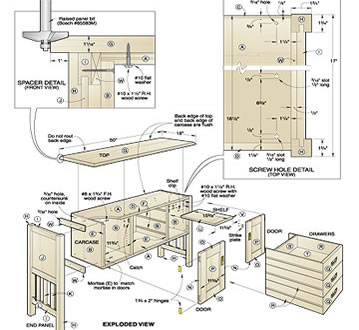
Best selling wood projects - An Elegant Jelly Cabinet Construction Part 5 Dovetailing the Carcass

Best selling wood projects

Best selling wood projects


I have an aversion to noise and dust in the workshop, so originally I was going to hand cut these dovetails.  Life - with all its unexpecteds - has a funny way of happening while we are making other plans.
And so it did ....
And so it has been a while since there were any Jelly Cupboardings ...............

Change of plan - use a jig and a router to cut the dovetails - handle the noise and dust and get on with it. Much quicker - even if noisy.

OK, these dovetails will be covered by the mouldings that I made earlier, so - nothing fancy - through dovetails will be fine.  And who makes the best through-dovetail jig in the world - Roger Gifkins of course - so lets use that.


Rogers through dovetail jig can be used on any router table.  My old Triton is perfect for this.
To cope with the dust and shavings, I have a shop made mdf dust hood that works reasonably well - held on here with an F-clamp.
The dovetails in the background are a set that I made from scrap, to test that the jig was registering correctly.

For a video demonstration of How to Use the Gifkins Dovetail Jig - see HERE

I found that my dust hose needed lengthening - what to do?


A supermarket fruit tin, with the top and bottom knocked out, fits like a glove.


Once the pins are cut on the ends of the top and bottom panels, it is time to address the tails on the side panels.  The Gifkins Jig makes light work of these as well, and a match with the top and bottom takes shape pretty easily.


It is important that the tails are cut on the side panels, and the pins on top and base. This is stronger in my opinion than the other way around.


A trial fit shows that the joint is pretty snug and will clamp up quite tight.


Here is the assembled carcass.  Not glued up yet, as the dados have to be cut for the shelves.  Easier to do before assembly.
The dovetails are cut a little proud - and will be planed back flush after glue up.

OK, not a bad afternoons work - following the mowing this morning.
Great to see things starting to take shape.
Time for a shower and an ale .................

..... and happy woodworking to all ...........
Best selling wood projects
Read More..

Senin, 22 Februari 2016

Best selling wood projects - An Elegant Jelly Cabinet Construction Part 3 Making the Back Panel

Best selling wood projects

Best selling wood projects


The back panel is going to be not-quite frame and panel construction.  It wont be quite a frame - only a pair of stiles.  These will be rebated to house the panel, which will be loose, and will slide in from the top.
In this way, the panel will be free to move with the seasons as the timber shrinks and expands.
The stiles need to be ready for when I make the carcass, as they will be attached to the sides.

I am going to use handplanes once again - a little Record 043 grooving plane, and my Stanley 289 skew rebate plane.

The little grooving plane will define the rebate.

Before that, I need to add an auxiliary fence so that it will register on the side of the timber - well along from the end.

This will assist in keeping the plane straight for the cut.

Here is the modified groover - ready for action:


I want the rebate to be 1/4 inch deep and 3/4 inch wide.


Cutting the groove first, establishes the boundaries of the cut for fashioning the rebate.  Once this is done, the remainder can be removed as waste.


I always start at the far end and work my way back to the near end - seems to work best with plough planes and little grooving planes.  These tight curlies are typical of this narrow cut - around 1/8 inch.


 Here is the finished groove - crisp and clean.  You can see why these planes are sought after for groove cutting for drawers,  and many other tasks in box making as well.


Once the rebate has been defined, the waste can be removed.  My trusty Stanley 289 fillister is a perfect choice for this, but any rebate (rabbet) plane will serve. Stanley 78s are the most commonly used in this situation.  The existing groove gives a constant check for the correct depth.


Here is the finished rebate.  Two stiles like this one will house the back panel, whose edges will be chamfered to fit the rebate.  These rebates wont be seen, but if they were I would give them a final smoothing with a shoulder plane with a nice tight mouth.
Ill cut this back panel after the carcass is assembled, to ensure a good fit.

More to come later.

Happy woodworking to all .........


Best selling wood projects
Read More..